
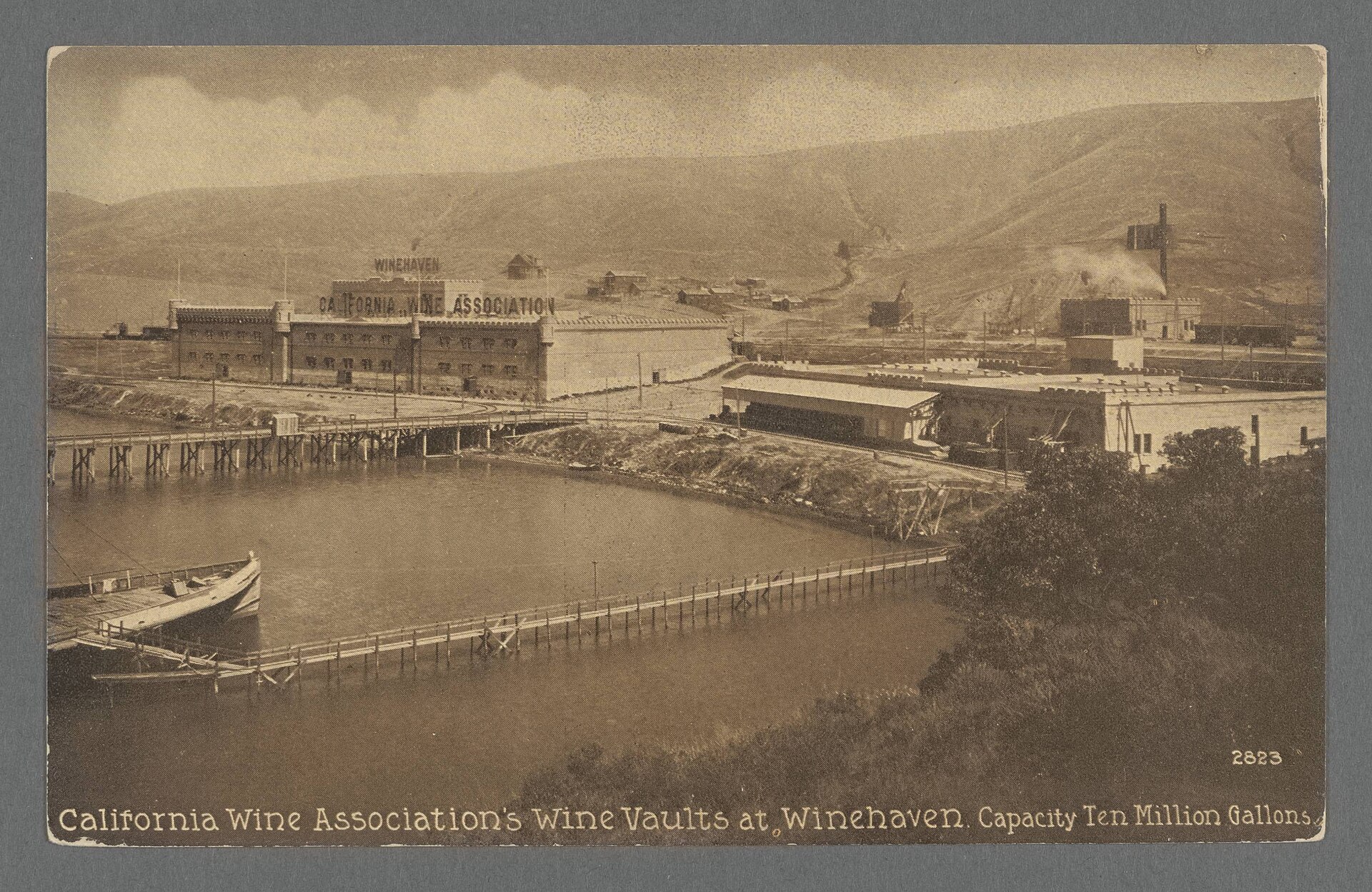
A winery that was also a town
Winehaven occupies a topographic bowl on the Potrero San Pablo peninsula, on Richmond’s western shore of San Pablo Bay. To the west is deep water. Hills close the site on the north, east, and south. That geography is why the California Wine Association chose it: rail could reach the cellars, ships could load at a private wharf, and a workforce could live on the slope above the plant.
From 1907 until Prohibition shut the operation down, Winehaven held the title of world’s largest winery. Period advertising claimed ten million gallons of storage. National Park Service accounts of the working plant record a shipping capacity of 500,000 gallons a month, with about forty vessels a year bound for New York alone, plus coastal and foreign cargoes. At the height of the crush, as many as 400 people lived on the grounds.
The plant did not vanish when the wine stopped. The same buildings later stored Navy fuel. A row of cottages that housed winery families later housed military families. The winemaster’s house became the commanding officer’s residence. What visitors still see — the crenellated brick, the long concrete cellar, the village street, the rusted rail — is that layered history, largely unaltered in plan from the winery years.
Timeline
- California Wine Association founded San Francisco merchants pool the state’s largest wine houses to stabilize a glutted market.
- Earthquake and fire CAWA’s San Francisco vaults are destroyed. The association buys land on the north side of Point Molate and begins a new plant.
- Winehaven rises Cellars, powerhouse, railway, and wharf go up. Most of the complex is running by the end of 1908.
- Company town complete Cottages, winemaster’s house, fire station, hotel, school, and a post office (1910–1925) make a working village. Peak employment reaches about 400.
- Prohibition The Volstead Act ends the wine trade. CAWA bottles grape juice, then winds the plant down. By the mid-1920s the buildings stand empty.
- Naval Fuel Depot Point Molate The Navy acquires about 412 acres, stores fuel in the old cellars, and builds hillside tanks and a new pier.
- National Register Lucretia Edwards and the Winehaven Historical Study Committee succeed in listing the district (NRHP 78000658).
- Base closure The fuel depot is decommissioned. The City of Richmond later takes title under the base-closure program.
- Winehaven Trust The Trust sues to force maintenance. Emergency tarps go on cottage roofs. The historic buildings remain at risk.
The peninsula before Winehaven
Point Molate is part of a longer human landscape than the winery. The East Bay Regional Park District, in describing its 2025 land purchase, named Native American sacred sites and a historic Chinese fishing village among the peninsula’s cultural resources. In the late nineteenth century, Chinese shrimp camps worked these shores, as they did at other points around San Francisco Bay. The later industrial peninsula — rail, oil, quarry, and shipping — grew around that older use of the water.
The name Molate is usually traced to Spanish moleta, a grinding stone. The point sits on the east shore of the bay, a short distance north of the Richmond–San Rafael Bridge, with East Brother Light Station visible to the west. Isolation from downtown Richmond was relative: close enough for a belt railroad, far enough that a large employer had to house its own people.
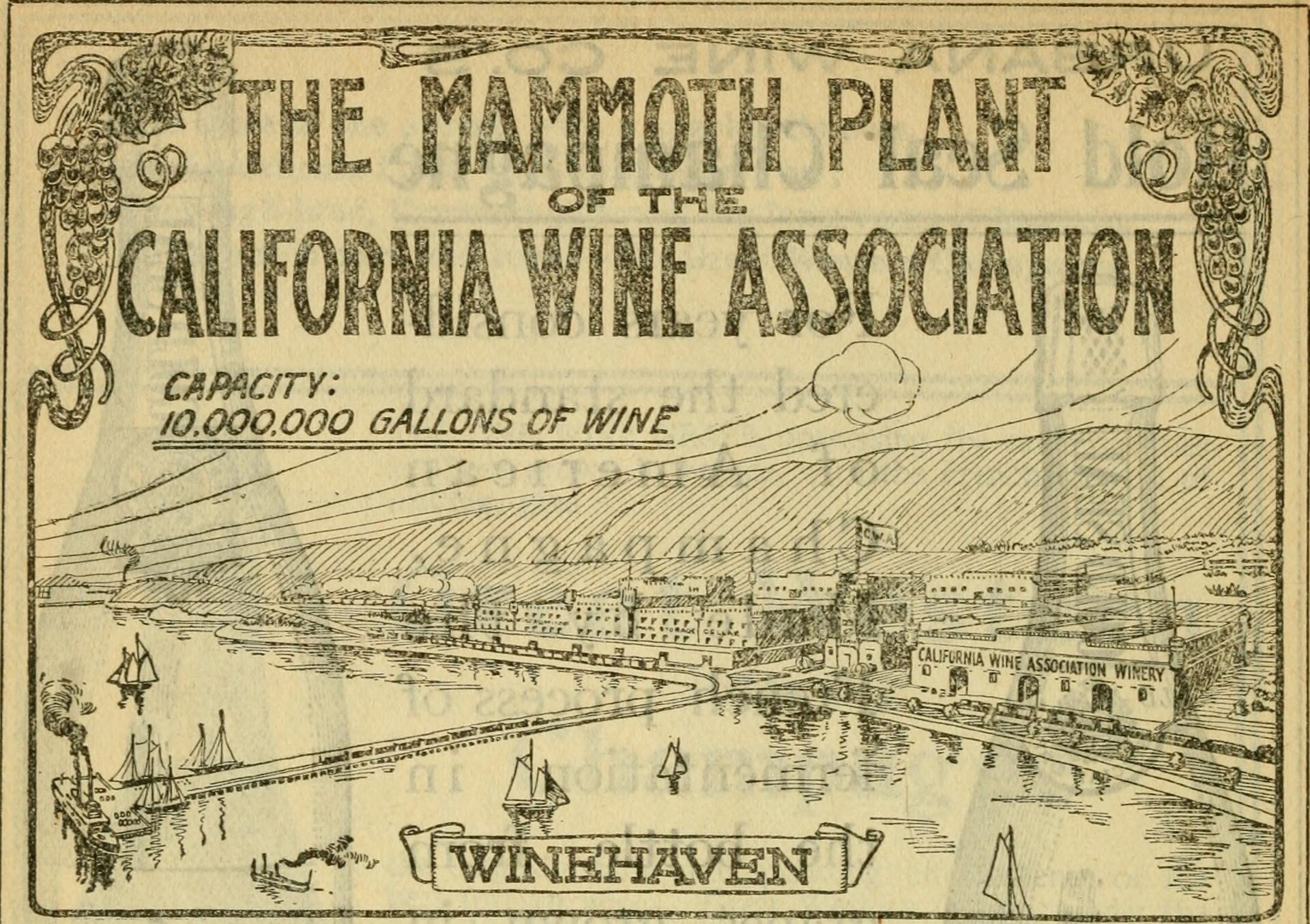
The California Wine Association
California’s commercial wine industry began in the south, around Los Angeles vineyards, then shifted north as Gold Rush settlement filled Napa, Sonoma, and the valleys feeding San Francisco. By 1890 most of the state’s wine was northern. Growers were many; marketers were few. Phylloxera, oversupply, and the panic of 1893 crushed grape prices.
In 1894, seven of the largest San Francisco wine merchants — several of them growers as well — formed the California Wine Association. The combination was large enough to dominate the trade. By 1902 its fifty-plus wineries produced nearly 30 million of California’s 44 million gallons. A 1910 association brochure claimed it made more wine than any other firm in the world. By 1914 it controlled about 84 percent of California’s wine manufacture. That volume pulled cooperage, presses, and crushers into local supply chains instead of European imports.
The association’s member vineyards and wineries stretched across Sonoma, Napa, Yolo, Solano, Contra Costa, Alameda, Santa Clara, Santa Cruz, Sacramento, San Joaquin, Fresno, Kings, Tulare, and San Bernardino Counties. Winehaven was not a picturesque estate winery. It was the shipping and storage machine for that network: the place where bulk wine became cargo.
After the 1906 earthquake
On April 18, 1906, earthquake and fire wrecked San Francisco. The giant wine houses that formed CAWA were almost all destroyed. Five association depots were lost. The inventory was not: CAWA still held more than $8.1 million in assets, including wine valued at more than $2 million. President Percy Morgan had long wanted consolidation. The disaster made a new, single plant thinkable.
Late in 1906 the association bought about forty-seven acres on the north side of Point Molate. Isolation was an asset. A full industrial campus could be laid out from scratch, with housing attached, on a shore that already had access to shipping and to rail tied into the transcontinental system. Construction began in 1907. The period of significance used in the National Register documentation runs from that year through 1920, when Prohibition ended wine production and distribution.
CAWA also fought its insurers. The dispute reached the U.S. Supreme Court, which ruled for the association in 1910.
Building the plant
The majority of the wine-producing complex was finished and in operation by the end of 1908; Sanborn maps show it complete by 1909. Buildings were numbered later by the Navy. The contributing industrial core includes:
- Building 1 (1908–1917) — the primary warehouse and wine cellar, about 800 by 185 feet, the district’s visual anchor.
- Building 6 (1907–1912) — a secondary cellar of unreinforced, board-formed concrete, about 650 by 144 feet, off the south end of Building 1.
- Building 10 (1908–1919) — loading dock and later refrigeration.
- Building 13 (1908–1916) — the powerhouse, with the tall stack still visible from the water.
- Building 17 (1907–1919) — workshop.
- Building 63 (1916–1919) — fire station.
- Internal railway (1907) — standard-gauge track at grade, historically on both sides of the main cellars, connecting plant, wharf, and the Richmond Belt Line.
A wharf ran about 1,800 feet into deep water west of Buildings 1 and 6. Winehaven kept its own electric switching engine to move freight cars on the pier and around the property. Grapes arrived by rail and by sailing scow. Finished wine left by rail and by ship. The railroads added two special freight trains a week to handle Central Valley grapes bound for the crush.
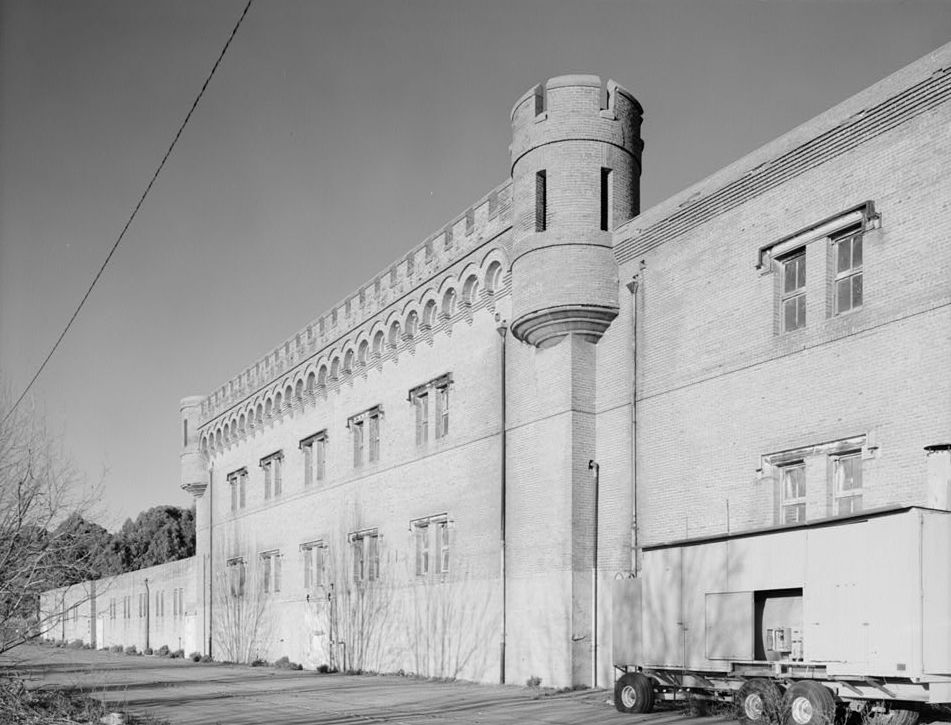
The cellars were built with the 1906 disaster in mind. Building 1 is a two-story steel-framed building with brick walls; its foundation and basement used reinforced concrete and fire-resistant design. Historic American Buildings Survey writers later called the main buildings “examples of fireproof and seismically reinforced industrial buildings designed in response to the 1906 earthquake.”
How Winehaven worked
This was bulk wine on an industrial scale. Grapes came in; fermentation, storage, and shipment went out. Period claims of ten million gallons of capacity match the 1908 almanac plate and the Edward Mitchell postcard. Monthly shipping of 500,000 gallons, recorded by the National Park Service, is the measure of the dock, not only the tanks. Forty ships a year to New York was in addition to coastal and foreign trade.
By 1907 the United States produced about 50 million gallons of wine, 40 million of it from California, and about 30 million of that from CAWA wineries. American wine was still little known abroad. Winehaven’s importance is domestic and industrial: it is the surviving plant of the firm that, for a generation, was California wine.
Ernest P. Peninou and Gail G. Unzelman, in their history of the association, called Winehaven “the largest and most up to date winery plant in existence.” That is the claim the brick was meant to advertise. The letters “CALIFORNIA WINE ASSOCIATION” once ran along the bay façade; “WINEHAVEN” sat on the roofline.
Architecture of a brick castle
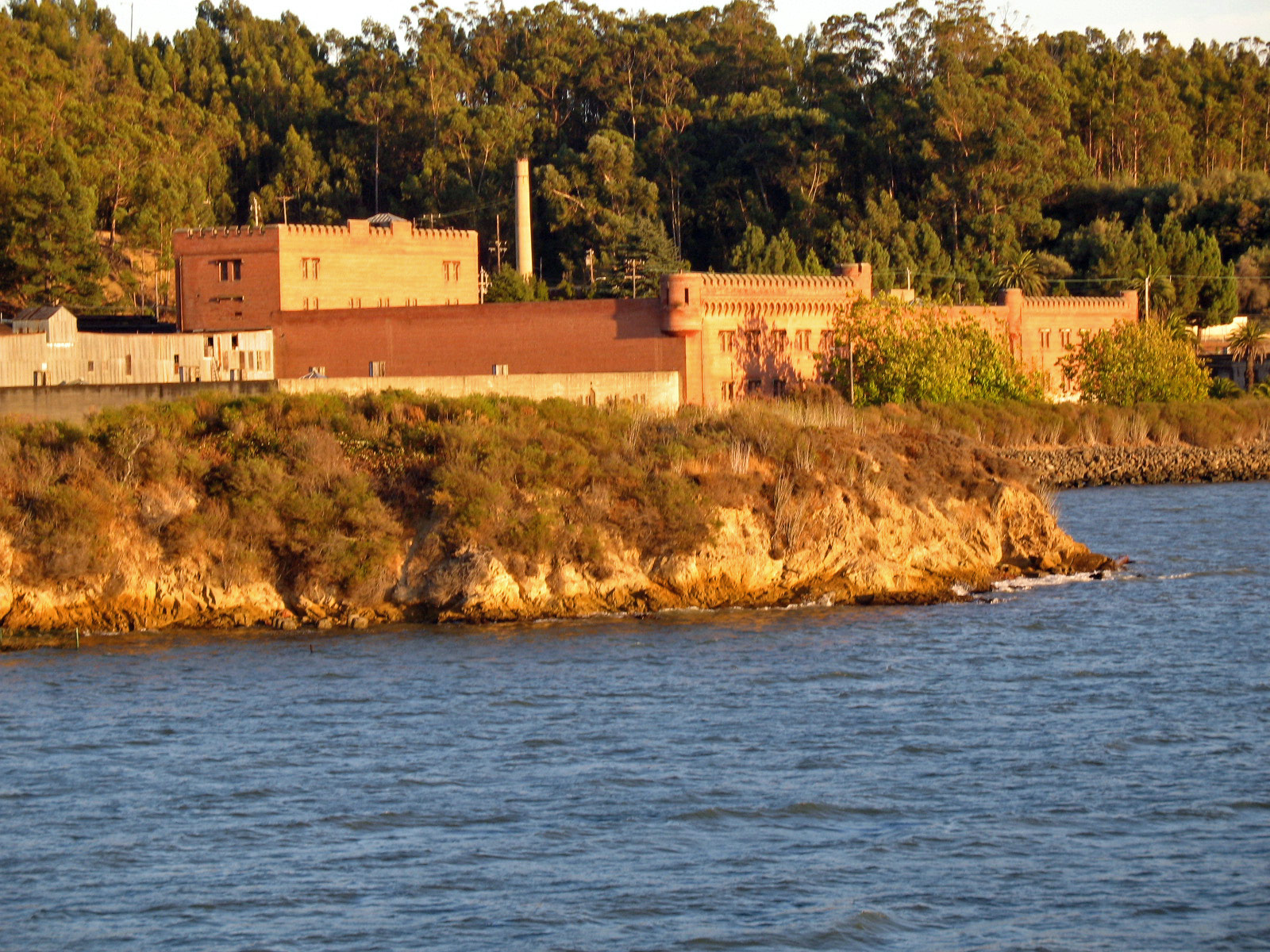
The original National Register nomination, prepared in 1976 by Lucretia Edwards, described the major buildings as “vast, massive, Teutonic and reminiscent of Rhineland castles,” of brick, with crenellated parapets and corner turrets. The 2021 boundary-decrease documentation classifies Buildings 1, 6, 10, and 13 as Late Gothic Revival industrial design. The architects are unknown.
Gothic Revival in the United States had already peaked in churches and houses. At Winehaven the style is used the way a bank used columns: to look permanent. Turrets, corbelled brick, stamped metal window hoods, and battlements face the bay. Narrow turret openings read as arrow slits. Building 1’s brick is largely a veneer on steel and concrete; at the turrets the brick is structural. Additions at the north end — a concrete wing and a narrower wood-frame wing — were in place by 1918 and belong to the historic period.
California has other castellated wineries, including the stone “English Gothic castle gatehouse” at what became Chateau Montelena. Winehaven is different in scale and in material: a working port plant, not a valley showpiece, using brick, concrete, and metal to recover from an earthquake on a deadline.
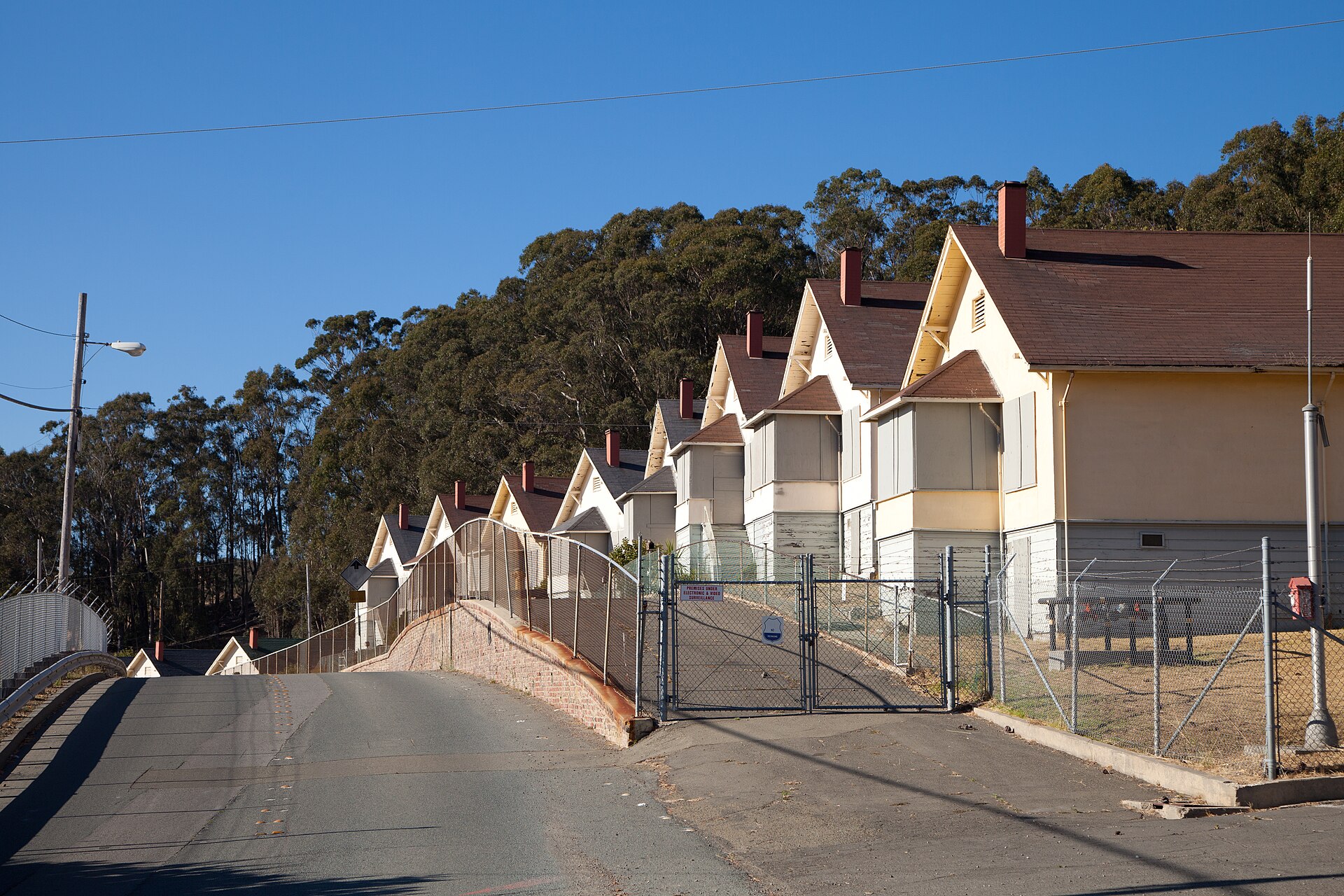
Residential buildings are another architecture. The cottages are bungalow types in three subtypes, wood-clad, lined up east of Stenmark Drive. The two-story Winemaster’s House (Building 60, 1910) sits farther upslope, looking over the plant. Together they are a company town, not a collection of trophy houses.
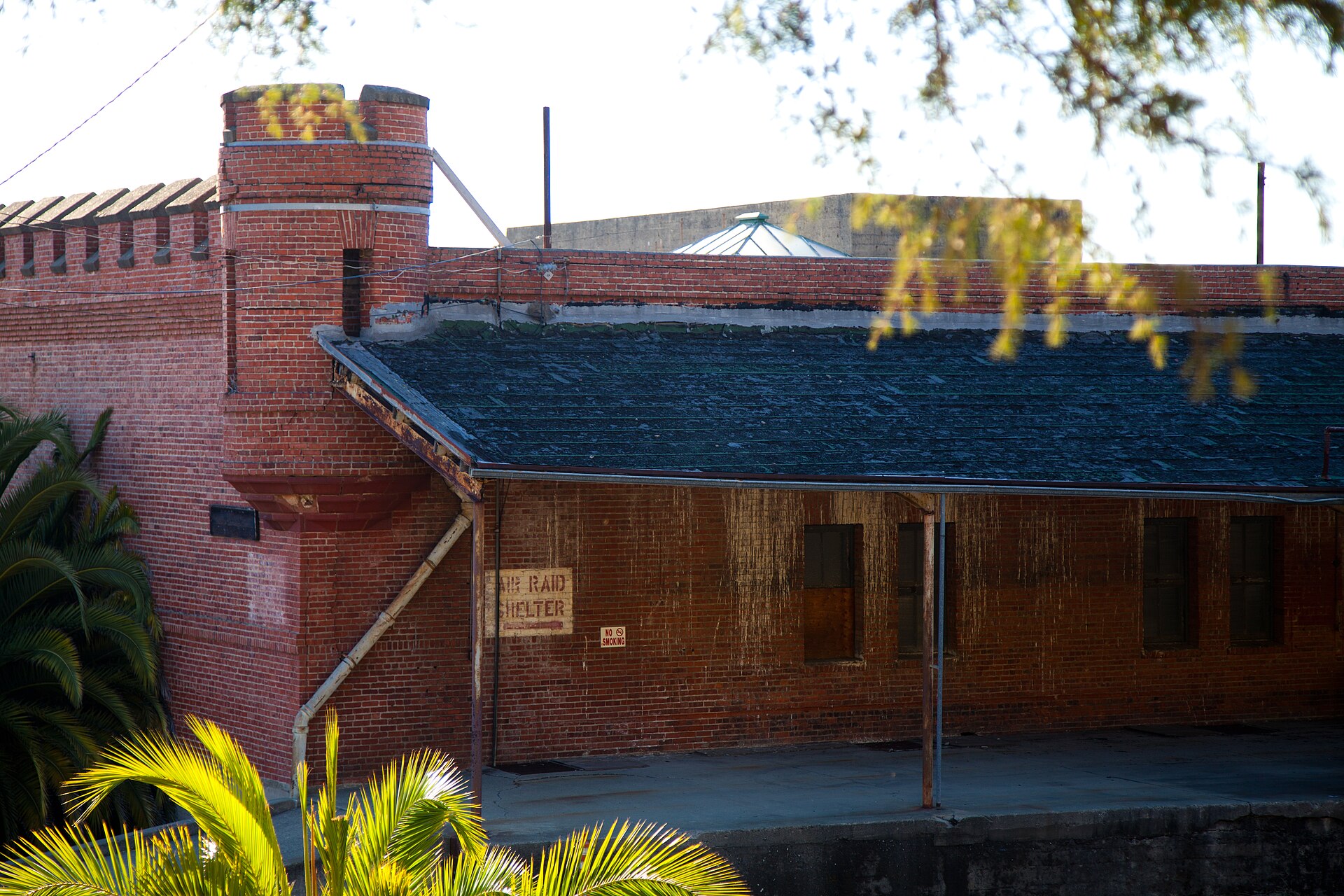
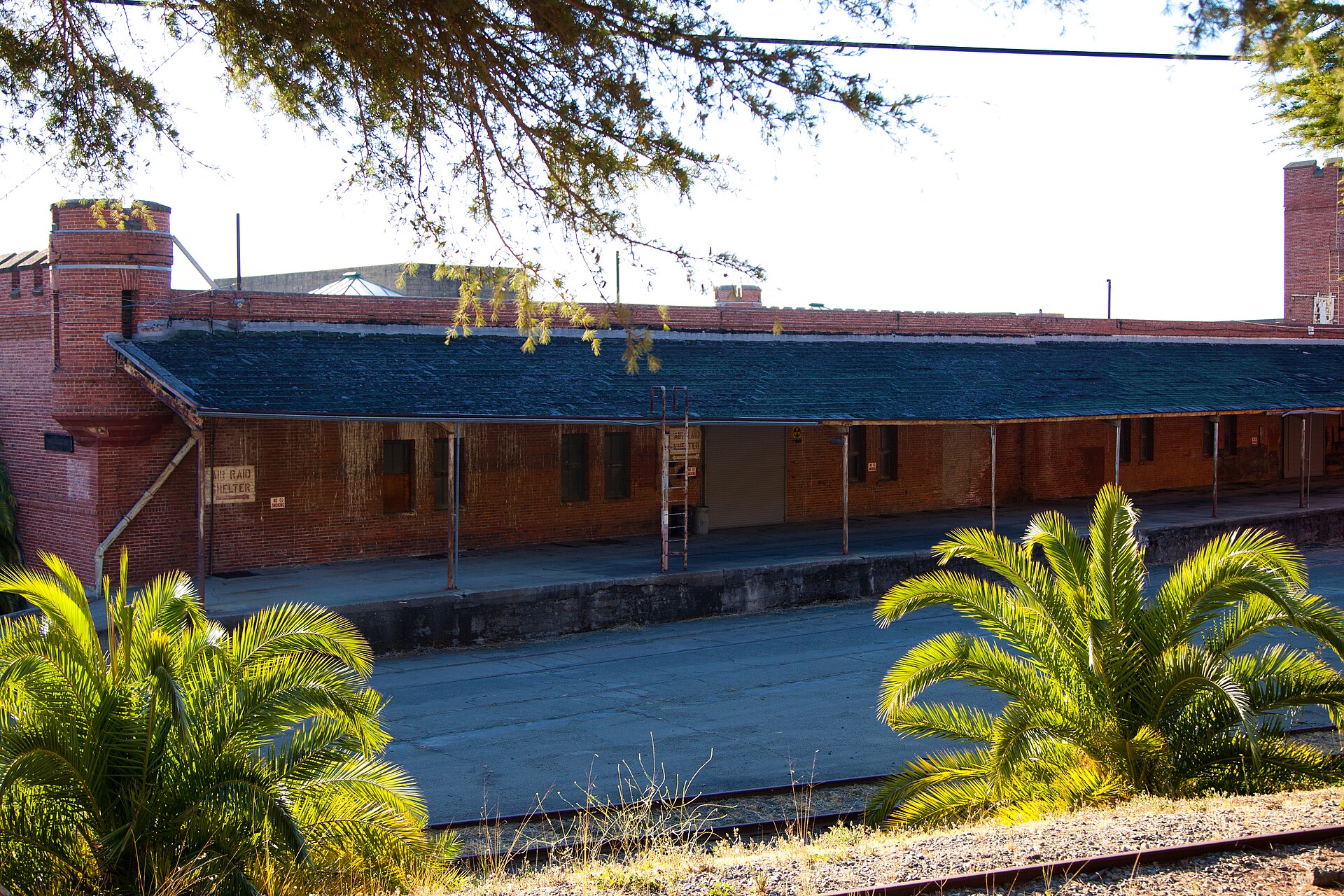
Navy-era stencils — “Air Raid Shelter,” “Fallout Shelter” — remain on winery brick. Photos by Almonroth, 2012. CC BY-SA 3.0.
Life in the company town
Because Point Molate sat apart from Richmond’s street grid, CAWA built a small town: hotel and boarding house, social hall, school, post office, steam plant, firehouse, cottages, and the superintendent’s house. A post office operated as Winehaven from 1910 to 1925.
Company towns were common in the western timber and mining belts. HABS researchers noted that Winehaven was unusual in three ways. It belonged to the wine trade, not extraction. It was not truly remote — Richmond and Oakland were nearby. And it never offered a full set of commercial services. It still provided work, housing, power, roads, and social rooms. The hotel, school, and social hall are gone. The manufacturing buildings, most of the housing, and much of the infrastructure remain.
Twenty-eight cottages (Buildings 31–54 and 56–59), built about 1910–1916, form the village. They later housed Navy families. Many windows are now boarded. Roofs have failed in places. Temporary tarps, installed after the Trust’s 2023 lawsuit, are a holding action, not a repair.
Primary paper records of daily life are thin. A 1967 fire destroyed the Naval Fuel Depot administration building and, with it, records that might have filled in names and routines. The 1976 nomination was written from interviews with children of Winehaven workers, local historical society members, and a newspaperman who had collected the early story. That oral record is part of why the buildings themselves matter: they are the archive that did not burn.
Prohibition and silence
State-by-state ratification of the Eighteenth Amendment, beginning in 1917, shrank the market before national Prohibition arrived. CAWA sold wineries, dissolved subsidiaries, and planned other uses for vineyards. Anticipating the Volstead Act of 1919, Winehaven produced two million gallons of grape juice. In 1920 a cold-storage unit was added to Building 6 to hold it. Juice was not a business. By the mid-1920s production had ceased and the buildings were vacant.
The association sold assets to stay solvent. Winehaven sat largely unused from about 1920 until the late 1930s. Repeal came in December 1933. Re-equipping a plant this size was judged too expensive. The castle on the bay stayed empty until the Navy needed tanks and warehouses in 1941.
The Navy years
After Pearl Harbor the Navy bought the 412-acre site and established Naval Fuel Depot Point Molate. Winemaking equipment came out. Oil drums went into the huge buildings. About twenty large concrete tanks were poured on the hillsides. Pipelines were laid. A new pier replaced the old winery wharf. The Winehaven Hotel served for a time as barracks and mess hall. Cottages were renovated for Navy families. The largest house on the bluff, built for the winery superintendent, became the commanding officer’s quarters.
The depot fueled ships through World War II, Korea, and Vietnam. It was decommissioned in 1995 under the Base Realignment and Closure program. Despite the change from wine to fuel, survey after survey has found the historic district “virtually unaltered” in the arrangement of its winery-era buildings. Fuel tanks and later structures sit mostly outside that core. A 2021 National Register boundary decrease reduced the listed acreage to about sixty acres and restated thirty-five contributing buildings plus the internal railway, stripping later Navy construction from the count that had padded the 1978 listing.
Signs of the military occupation remain on the brick: fallout-shelter stencils, building numbers, “no smoking” rules written for fuel, not fermentation.
The National Register district
Winehaven was listed on the National Register of Historic Places on October 2, 1978, as district number 78000658. The nomination was the work of Lucretia Edwards and the Winehaven Historical Study Committee. Later documentation, prepared for a boundary decrease listed on November 15, 2021, states local significance under Criterion A (commerce and industry) and Criterion C (architecture). The period of significance is 1907–1920.
Contributing resources named in that form include the two great cellars, the loading and refrigeration building, powerhouse, workshop, fire station, cottages, Winemaster’s House, and the internal railway. The district is significant both as the surviving plant of the California Wine Association and as an intact industrial Gothic and company-town landscape.
Historic American Buildings Survey teams documented the complex in 1996 (HABS CA-2658 and related records), including the storage cellar, fermentation room, warehouse, powerhouse, workshop, firehouse, cottage types, and the winemaster’s house. Those measured drawings and photographs are in the Library of Congress.
After the Navy, and now
The Navy transferred land to the City of Richmond beginning in 2003 (218 acres for one dollar) and completed transfer of remaining acreage in 2010, with cleanup funds. Point Molate has since been the subject of reuse plans, a rejected casino proposal, litigation, a mixed-use entitlement that did not close, and, in 2025, purchase of 82 acres by the East Bay Regional Park District for a regional shoreline. Through those ownership changes, the historic buildings have had little more than security fencing and, after 2023, tarps on some cottage roofs.
Winehaven Trust was formed to insist that listing on the National Register is not a memorial plaque. It is a duty to keep water out of the attics and brick on the turrets. Building 1 still needs a roof, drainage, and turret stabilization. The cottages still need more than plastic. The Trust’s lawsuit, filed in 2023, is the public record of that demand.
If the cellars and cottages are kept, they can tell a complete story: Chinese shrimp camps and Native sites on the same peninsula; the association that industrialized California wine; a company town on a rail spur; Prohibition’s empty vats; a Navy fuel depot; and a city still deciding whether a landmark is an asset or an inconvenience. If they are not kept, the story survives only in postcards and HABS files. The buildings are the evidence.
From the Tom Butt E-Forum
Former Richmond mayor Tom Butt, president of Winehaven Trust, has written about Point Molate and Winehaven for years in his personal newsletter, the Tom Butt E-Forum. The posts are not City of Richmond documents. They are a running public record of how the site was transferred, litigated, sold, and left without a funded plan to keep the historic buildings standing.
Read together, the E-Forum’s Winehaven and Point Molate posts make a consistent argument. After the Navy closed the fuel depot in 1995, Point Molate became the subject of reuse fights that still have not produced a steward for the winery. The City took title from the Navy, later sold developable acres under a court settlement, and — in Butt’s account — remained contractually responsible for maintenance even after later transfers, including to the East Bay Regional Park District. He writes that the City has not been a good steward: decades of minimal upkeep, and only the Trust’s 2023 lawsuit moved the City Council to put temporary tarps on some cottage roofs, with no comparable protection for Building 1 and the rest of the district.
In April 2023 he published the Trust’s complaint against the City and Point Molate Futures, LLC, over failure to maintain the historic structures. Later posts track what followed: a reluctant 2023 Council vote to tarp cottages; the collapse of mixed-use development after CEQA and contract disputes; continuing city spending on litigation, security, and upkeep; and park-acquisition news that, he argues, still leaves Winehaven without a rehabilitation plan. In May 2026, after a Historic Preservation Commission presentation titled “Proposed Partial Demolition of Bldg. 1 Due to Weather Damage,” he wrote that the real cause was the City’s failure to maintain the building — demolition by neglect — and that a demolition permit for a historic structure is discretionary and subject to CEQA, to be filed by the owner.
The selected posts below are among the E-Forum entries that deal directly with Winehaven or Point Molate. Earlier years are indexed in the archives.
-
The Beginning of the End of Winehaven?
On a Historic Preservation Commission briefing about partial demolition of Building 1 because of weather damage, and on the City’s continuing maintenance duty after Navy transfer, tribal sale, and park-district purchase.
-
Point Molate Purchase Falling Apart?
On the park-district purchase, the SunCal (Winehaven Legacy, LLC) contract lawsuit, a lis pendens on title, and ongoing city costs for litigation, security, and maintenance.
-
Point Molate Update — Park District grant, Winehaven still without a plan
On Coastal Conservancy funding for park acquisition and the absence of a specific plan for the Winehaven district north of the planned shoreline park.
-
Point Molate Continues to be a Money Pit for the City
On CEQA appeals, the SunCal damages case, and Winehaven’s continued deterioration after the City acquired the land from the Navy for $1 and later sold acreage for $400.
-
What Does 2024 Hold for Point Molate and Winehaven?
Year-end status of litigation, the cottage-tarp work prompted by the Trust lawsuit, and public debate over whether Winehaven should be reused or cleared for parkland.
-
Winehaven Trust Sues City of Richmond and Tribe Over Lack of Winehaven Maintenance
Announcement of the Trust’s complaint for injunctive relief and municipal-code violations after the City ended the SunCal project and left the historic buildings in limbo.
-
Forgotten Tales of Point Molate – Winehaven
An illustrated history of the California Wine Association plant, Prohibition, the Navy years, and the 1978 National Register listing.
More Point Molate and Winehaven titles appear in the yearly indexes: 2022, 2023, 2024, and the current E-Forum. Related posts include Who Will Bear the Cost of Ongoing Point Molate Litigation? and RPA Controlled City of Richmond Fails at Historic Preservation (May 29, 2024).
Continue to the photograph gallery
Sources
This account is a synthesis of public records and published histories. It does not invent names, case results, or unattributed quotations. Principal sources include:
- National Park Service, “Winehaven (Point Molate),” World War II in the San Francisco Bay Area. nps.gov/places/winehaven.htm
- National Register of Historic Places, Winehaven Historic District, NRHP 78000658 (listed 2 October 1978); boundary decrease 15 November 2021. Original nomination by Lucretia Edwards, Winehaven Historical Study Committee, 1976.
- Historic American Buildings Survey, Winehaven, Point Molate Naval Fuel Depot (HABS CA-2658 and related), Library of Congress.
- California Office of Historic Preservation, Winehaven Historic District (Boundary Decrease) registration form.
- Ernest P. Peninou and Gail G. Unzelman, The California Wine Association and Its Member Wineries 1894–1920 (Santa Rosa: Nomis Press, 2000), as cited in National Register documentation.
- Thomas Pinney, A History of Wine in America from the Beginnings to Prohibition (University of California Press), as cited in National Register documentation.
- City of Richmond, “Lost Secrets of Molate and the San Pablo Peninsula” history presentation.
- Point Richmond history notes on Point Molate; East Bay Regional Park District announcements, 2025.
- Grandview Independent reporting on Winehaven Trust, 2023, including public statements by Tom Butt and Rosemary Corbin.
- Tom Butt E-Forum posts on Winehaven and Point Molate, 2022–2026, linked in From the Tom Butt E-Forum.